
The US tinnitus app market is getting crowded. Sound masking apps, CBT programs, mindfulness tools, AI-driven platforms; there are more options every year, and audiologists are increasingly being asked to recommend them. The question isn't whether digital tinnitus tools have a place in clinical practice anymore. Most do. The question is which ones are worth recommending, and why.
US audiologists are more open to adopting digital tinnitus solutions as supporting tools — a shift that has happened quickly. But adoption doesn't mean the tools are equal. And the landscape includes some real failures worth learning from.
What's already out there and what happened to it
The existing digital tinnitus landscape broadly falls into a few categories: sound masking apps that provide relief through background noise, CBT-based platforms that deliver structured therapy programs, and mindfulness tools that help patients build tolerance and reduce distress. These approaches have real value. CBT in particular has the strongest evidence base in tinnitus management, and digital delivery makes it more accessible than waiting months for a face-to-face referral. For many patients, they're a meaningful step forward. What most of them share is that they work around the tinnitus, teaching patients to think differently about it, mask it, or relax in its presence. The mechanism is learning and coping. That works for a significant number of people. But for others, particularly those who have already tried the standard routes and still find their tinnitus overwhelming — something more active is needed.
Where Freequency is different
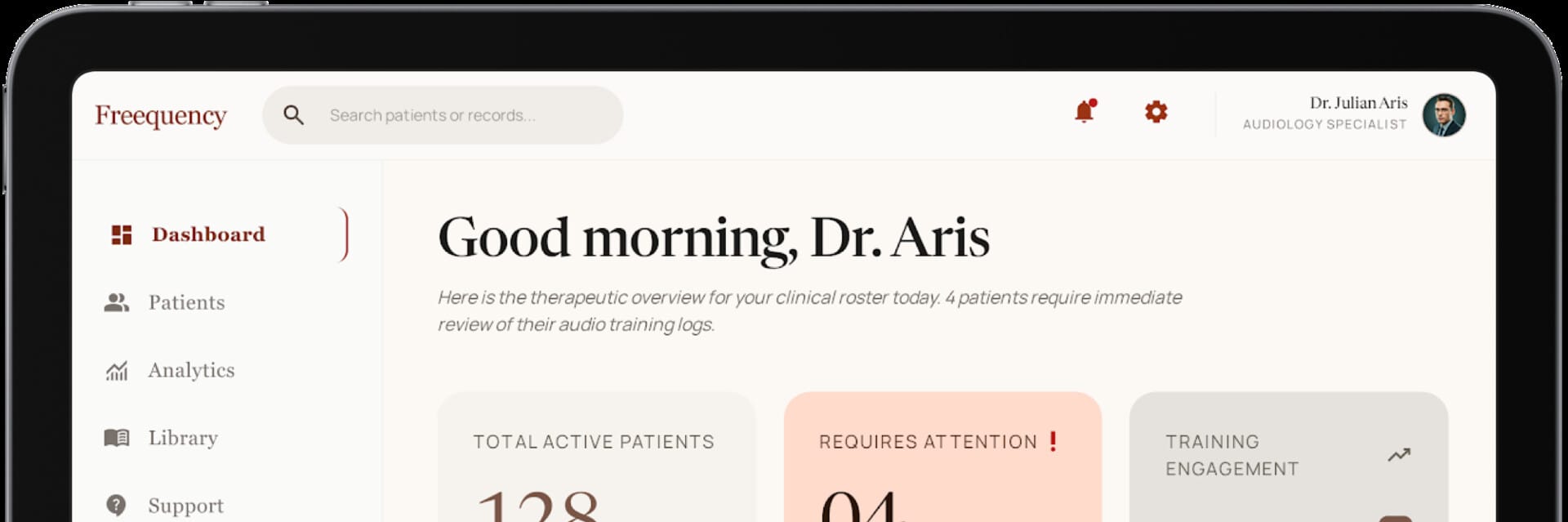
Freequency is built on a different premise: active engagement, not avoidance. The app uses augmented reality and spatial audio to guide users to directly confront their tinnitus signal; not suppress it, not distract from it, but engage with it in a structured, daily practice grounded in exposure therapy and Acceptance and Commitment Therapy.
"Exposure allows people to respond more flexibly to tinnitus," says Steven C. Hayes, PhD, co-founder of ACT and a member of Freequency's clinical advisory board. That flexibility — the ability to have tinnitus present without it dictating your behavior — is what the evidence actually shows makes a lasting difference for people with chronic tinnitus.
That's a meaningful distinction from what most apps offer. CBT delivered through an app teaches cognitive strategies. Mindfulness teaches tolerance. Freequency trains the response itself — ten minutes a day, through a format that keeps people coming back.
The advisory board reflects that ambition. Professor Gerhard Andersson, pioneer in internet-delivered CBT for tinnitus at Linköping University, reviewed the methodology and found the combination of ACT principles with a gamified format well-executed. Tricia Scaglione, Au.D., MBA, DFAAA, CCC-A, Distinguished Fellow of the American Academy of Audiology, contributed clinical content and has been an advisor since early development. Dr. James Henry, with 35+ years of tinnitus research and over 250 publications, shaped the scientific framework.
These are not marketing endorsements. They're researchers and clinicians who asked hard questions about the approach and found it credible.
What the evidence shows
In April 2026, Freequency published a white paper authored by Cathelijne van der Zwan (BSc, Delft University of Technology) and Jan de Laat, PhD, medical physicist and audiologist at Leiden University Medical Center. The analysis covers user-reported TFI outcomes from 110 Dutch participants who completed two or more measurements between August 2025 and April 2026.
The results: 41.8% of users achieved a clinically relevant improvement (TFI reduction of ≥9 points) and 32.7% a clinically significant improvement (≥13 points). The mean TFI score dropped from 48.1 to 41.0, a reduction of 7.15 points (95% CI 4.77–9.52; p <.001).
Among users who completed three or more measurements — which the authors note may indicate adherence — 52.8% reached the clinically relevant threshold and 47.2% the clinically significant threshold. Mean TFI reduction in this group was 10.58 points (p <.001).
The domain breakdown is worth noting. Statistically significant improvement was found across seven of eight TFI domains: relaxation, auditory functioning, sense of control, emotional functioning, quality of life, intrusiveness, and cognition. Sleep showed a trend but did not reach significance.
One finding with direct clinical implications: participants with higher baseline severity showed greater improvement on average (Pearson r = 0.22, p =.021). Among users who started with a TFI score in the "big problem" range (54–72) and reported three or more times, two-thirds showed clinically relevant and significant improvement. The app appears to work best for the patients who need it most.
The limitations are stated clearly in the paper: voluntary participation, non-uniform measurement timing, and no tracking of usage frequency. These are real constraints. The authors call for a larger, preferably multicenter study across both the Netherlands and the US. That follow-up study is now underway in the Netherlands, and initial discussions about US-based research are ongoing.
Download the full white paper here.
What this means for your practice
The audiologists who work with Freequency aren't being asked to endorse a product. They're being asked to connect patients with something that takes a fundamentally different approach to the problem.
The pilot is ongoing. If you treat tinnitus patients and want to understand how Freequency fits into a clinical pathway, get in touch at
Freequency is a mobile app and augmented reality based game designed to support tinnitus management. It is not a medical device and does not replace clinical assessment or treatment.